
In this guide (8)
- 1The real cost of building an ecommerce store isn't the quote
- 2Ownership or rental: the difference that changes everything
- 3Performance and security aren't “extra options”
- 4What changes when ecommerce development is built on a flat-fee model
- 5Direct comparison: what happens after the first sale
- 6How the development process actually works
- 7When this model makes sense (and when it doesn't)
- 8The next step isn't another generic quote
Almost all guides on ecommerce development start from the choice of platform or the number of weeks needed to go live.
Very few start from the question that decides whether the store will generate profit or burn margin: how much do you actually keep in your pocket on every single sale?
This is the blind spot of most projects. There's talk of design, delivery times, SEO plugins, but it's ignored that the chosen platform can silently take away 2.5–4% of every order for the entire life of the store. On an annual revenue of €200,000 that percentage becomes a fixed cost of thousands of euros that never appears in the initial quote.
The real cost of building an ecommerce store isn't the quote
There are three cost levels that almost no one puts in the same spreadsheet:
Entry cost (development, design, catalog upload)
Annual management cost (hosting, updates, security, support)
Variable cost on sales (platform fees, mandatory apps, extra gateways)
The first two are visible. The third is invisible until you start selling.
Shopify, for example, takes a percentage on every transaction. The more you sell, the more you pay. Essential apps (email recovery, reviews, upsell, advanced feeds) add hundreds more euros a month. After three years, many stores discover they've spent more on fees and apps than they would have spent on a custom project.
The same pattern repeats with “cheap” solutions based on WooCommerce or PrestaShop: the initial quote is low, but every serious feature requires paid modules, and technical maintenance grows with the complexity of the catalog. We discussed this in detail in Cheap ecommerce website: is it really worth it, or is it a trap? and in 3 years, two quotes: why the website with the lowest initial quote will cost you more.
The right question isn't “how much does it cost to build”, but “how much will it cost me to sell on it for the next five years”.
Ownership or rental: the difference that changes everything
Another point that is systematically underestimated is the distinction between an owned website and a rented website.
When you use a SaaS platform, you don't own the store. You only own the raw data (products, customers, orders). Design, structure, custom logic and technical history remain on the provider's server. If you ever decide to leave, you have to rebuild everything from scratch.
We explained the concrete consequences in Is your website rented or owned?.
In professional ecommerce development this difference isn't philosophical: it determines whether you can migrate, whether you can integrate a complex management system without structural limits, whether you can export the entire project, or whether you're tied to a de facto permanent contract.
Performance and security aren't “extra options”
A slow store isn't an aesthetic problem. It's a conversion problem.
Beyond 2.5–3 seconds of loading time, the bounce rate rises sharply. On WooCommerce the most frequent causes are database autoload and plugins accumulating over time (we discussed this in WooCommerce slow? Real causes and how to speed it up).
Security follows the same logic. A WAF installed as a plugin is an added piece. A WAF native to the platform's core is a layer of protection that can't be disabled by mistake or forgotten in an update. For those handling customer data or, worse, healthcare or legal data, this difference is non-negotiable.
Your profit margin is already being reduced by a traditional sale:
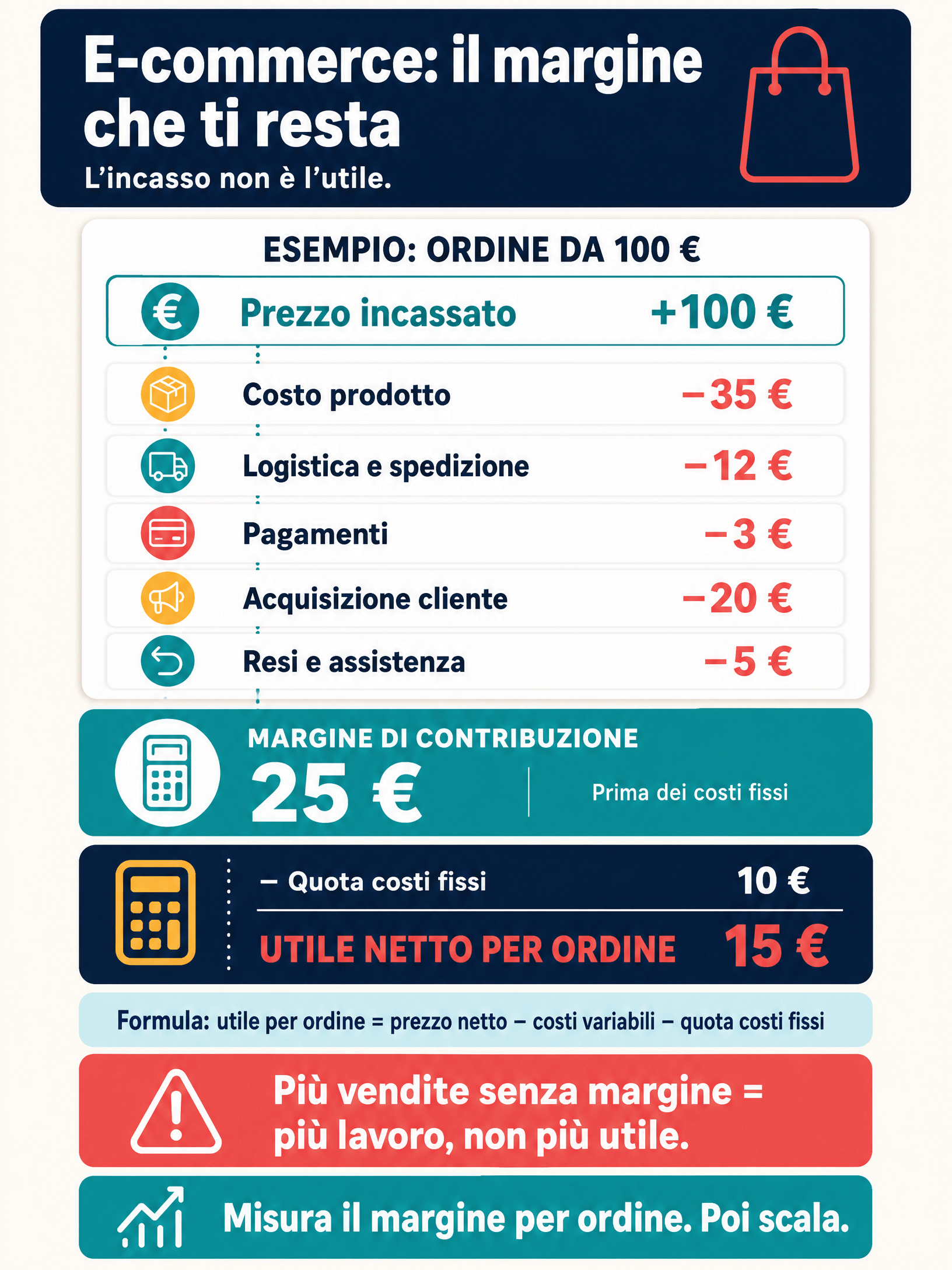
What changes when ecommerce development is built on a flat-fee model
This is where KeideaCMS's concrete difference comes in.
Instead of a development quote + monthly fee + commissions + apps, the model is a fixed, all-inclusive annual fee.
Today the Business plan is €1,188 a year (€99 a month if paid annually). It includes:
Catalog with unlimited variants and compatibility matrix
Stock management, threshold alerts, movements
Automatic abandoned cart recovery with configurable emails and coupons
Native XML feeds for Google Merchant Center and CSV for Trovaprezzi
Stripe, PayPal and bank transfer payments with no platform fees
B2B validation (VAT number, tax code, SDI, multi-rate)
Hosting, backup, updates, proprietary WAF and native SEO (meta, Schema.org, sitemap)
Direct support in Italian from a dedicated person
Zero sales commissions, forever
The store goes live in 7 business days starting from the materials provided (photos, text, logo, price list). There's no template rebuilding or plugin installation. It's the same platform that runs KeideaCMS's own website.
This model eliminates the variable cost on sales. On annual revenue of €150,000, the absence of platform fees can mean thousands of euros staying in the margin instead of going into fees.
It's the same reasoning we developed in Selling online: how much do you actually keep from each sale?.
Direct comparison: what happens after the first sale
| Cost item | Typical Shopify / SaaS | WooCommerce / PrestaShop + agency | KeideaCMS |
|---|---|---|---|
| Initial development | €2,500–8,000 | €5,000–25,000 | Included in the fee |
| Annual fee / hosting | €400–1,200 + apps | €800–3,000 + modules | €1,188 fixed |
| Sales commissions | 1.9–2.9% + fee | None | None |
| Essential apps / modules | €50–300/month | €300–1,500/year | Included |
| Maintenance and updates | Included (with limits) | Client or agency's responsibility | Included and managed |
| Project ownership | No or with limits | Yes | Yes, we export the data present in the database |
| Time to go live | 1–4 weeks | 6–16 weeks | 7 business days |
The complete feature-by-feature comparison is available on the pages KeideaCMS vs Shopify and KeideaCMS vs PrestaShop.
How the development process actually works
You provide the price list, photos, texts and logo.
The team sets up the catalog, payments, feeds and stock rules on the proprietary platform.
Within 7 business days the store is online, tested and reachable.
From that moment you manage products, orders and content from the panel in Italian without touching any code.
If an integration with an existing management software or ERP is needed, it is built on the company's actual workflows, not on generic connectors.
There is no "extraordinary maintenance phase" because updates and security are managed centrally.
There is no "I have to call the developer to change a discount rule" because the panel is designed for the sales team, not for programmers.
When this model makes sense (and when it doesn't)
It makes sense if:
You want to know exactly how much your store will cost you in three years
You prefer to keep 100% of the margin on every sale
You need complex variants, B2B price lists or synchronization with management software
You don't want to depend on a plugin ecosystem that breaks with every update
You prefer a contact in Italy who knows the project instead of generic tickets
You want to rely on a team of true professionals, engineers, AI and cybersecurity experts who don't just have words but professional certifications. We're talking about professionals who have fully completed traditional educational paths and subsequently obtained further specializations and certifications. Check the background of who will work on your project
It doesn't make sense if:
you're running a market test worth a few hundred euros or if you just want a sales link on Instagram without any infrastructure.
The next step isn't another generic quote
If you're evaluating an ecommerce development project and want to understand how much you'll really have left after commissions, apps and maintenance, the fastest way is to compare the numbers against your specific case.
Go to the dedicated page → Professional Ecommerce Development
or request a direct technical analysis of your current project.
This isn't a standard quote. It's the calculation of the margin you have left once you remove the percentages and variable costs.
Because in the end, ecommerce development isn't a project to close. It's the structure that decides, every day, how much of what you sell stays yours. Don't want to go any further? Fill out the form below, and we'll get back to you.