In this guide (8)
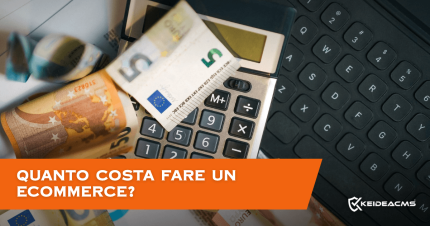
How much does it cost to build an ecommerce site in 2026? There is no single price, but there are clear orders of magnitude and, above all, a series of hidden costs that the initial quote almost never makes clear. In this guide we look at the real market price ranges (DIY, subscription platform, agency, managed CMS), what the bill is actually made up of, which expenses show up only after launch, and why the right question is not how much it costs today, but how much it costs over the next three years.
We have been managing websites and online stores for several years, and the question we get asked most often is always the same: "how much does it cost to build an ecommerce site?". It's a legitimate question, but the clear-cut answer many people are looking for, a single number, simply doesn't exist. However, there are clear orders of magnitude, there is an honest way to read a quote and, above all, there is a series of costs that almost no one makes clear at the time of signing and that show up punctually after launch. This guide lines up the real market prices in 2026, what the bill is actually made up of, what the hidden costs are, and why the right question isn't how much it costs today, but how much it will cost over the next three years.
Why there's no single price
Asking how much an ecommerce site costs is a bit like asking how much a house costs: it depends on how big it is, how it's built and who builds it. Two seemingly similar online stores can have very different quotes because the number of products to upload changes, as do the integrations required with warehouse, management software and shipping, the amount of content to write and the graphic care. A catalog of twenty items with standard payment and shipping is a world away from a store with thousands of items, variants, different price lists and synchronization with management software.
There is then a second reason, less obvious but more important: two different quotes are often not describing the same work. One may only include the initial technical setup, another may also include content, security and ongoing support. This is why comparing two figures without looking at what they include is the quickest way to choose badly. Before getting to the numbers, then, keep in mind that the price is always the answer to a precise question: "what, exactly, is included?".
How much it really costs in 2026: market ranges
That said, some reference numbers are useful, if only to understand what order of magnitude we're dealing with. There are four main ways to build an ecommerce site, each with a different cost logic. The table below shows the most common market ranges in 2026, keeping the initial expense and the recurring one separate, as the latter is almost always underestimated.
| Route | Initial expense (order of magnitude) | Recurring cost | Suited to |
|---|---|---|---|
| Do-it-yourself (ready-made platform) | Very low, often close to zero | A few hundred euros a year between subscription and tools, plus your time | Those starting small and with time to dedicate to it |
| Subscription platform (cloud SaaS) | Low (setup and theme) | Monthly or annual fee, paid apps and possible sales commissions | Those who want to launch quickly while accepting recurring costs |
| Agency or developer (custom-built) | From a few thousand euros, over fifteen thousand for complex projects | Hosting, modules, updates and support billed separately | Those with specific needs and a budget dedicated to maintenance |
| Managed proprietary CMS (subscription-based) | Limited or included in the fee | Fixed fee that includes maintenance, security and support, with no sales commissions | Those who want to sell without dealing with the technical side |
The numbers in this table are orders of magnitude, not price lists: they are meant to frame the expense, not replace a quote. If you're already collecting offers and want to understand how to compare them item by item, we've dedicated an article to the cost items of an ecommerce quote, while in the complete guide to building an ecommerce site you'll find the project phases and a comparison of platforms.
KeideaCMS
Do you have a quote in hand and don't know if it's worth it?
Request a free analysis →Compare your quote
What makes up the bill
To understand whether a price is high or low, you need to know what's in it. The cost of an ecommerce site is never a single figure, but the sum of a few items that almost always come up, regardless of the route chosen. Knowing them allows you to read any quote with a critical eye.
Analysis and planning. The part that's least visible but weighs most on the outcome: defining the catalog, the purchase journey, the pages and functions that are truly necessary. A poorly thought-out project costs little at the start and a lot later on.
Design and development. The actual build of the store: look and feel, product pages, cart, checkout, and how it renders on mobile, which now accounts for most purchases.
Content. Photos, product page copy, and category page text. This is the most underrated item: descriptions copied from the supplier don't rank and don't sell, and writing them well takes time or budget.
Integrations. Payments, shipping, invoicing, connection with management software or warehouse systems. Every integration adds value but also complexity and cost.
Hosting and infrastructure. The space the store runs on, its speed and its stability. A slow ecommerce site loses orders, so this isn't an item where it pays to cut corners.
Security and maintenance. Updates, backups, data and payment protection. This isn't a one-off cost but an ongoing one, and ignoring it is the fastest way to turn an initial saving into an unexpected expense.
When comparing two quotes, the question to ask for every item is always the same: is it included, and is it included for life or just for the first year? The answer to this question is worth more than the figure at the bottom of the quote.
The hidden costs the quote doesn't show you
This is the heart of the matter, and it's the part that makes the difference between an ecommerce site that costs what was expected and one that, month after month, eats into your margin. Hidden costs aren't scams: they're simply real expenses that tend not to appear in the initial quote, because they come later. These are the most common ones we see.
| Hidden cost | When it hits | Why it matters |
|---|---|---|
| Additional modules and apps | Right after launch, when you need functions that are "not included" | Many features taken for granted are paid add-ons and add up every year |
| Sales commissions | With every order | A small percentage seems minor, but it grows along with revenue |
| Updates and security | Over time, with every new version or vulnerability | Without maintenance, the site ages, slows down, and is exposed to real risks |
| Your time | Every day | It's the least visible cost: hours taken away from selling to handle technical issues |
| Technical interventions | When something breaks | A cart that freezes up or a failed update turns into an unexpected bill |
The trickiest case is sales commissions: they're convenient at first because they push the cost forward, but they become the heaviest item as the store grows. We covered this in detail in the article on the commission trap and on how much you actually keep from every sale. The practical rule is simple: before signing, ask for the full list of what's excluded and how much it amounts to each year.
The real cost is calculated over three years
If there's just one thing to take away from this guide, it's this: the cost of an ecommerce site shouldn't be assessed on the starting figure, but on the total over the first three years. This is the right time frame because it includes the launch and all the day-to-day management, and that's exactly where the differences between solutions become clear and often get turned upside down.
Let's reason this through, without made-up numbers. A solution that costs little at the start but lives on fees, apps and commissions may turn out to be the cheapest in month one and the most expensive by year three, as sales grow and the percentages grow with them. A custom project with a high upfront cost may seem demanding, but if maintenance is well managed it can level out. A fixed fee, finally, has the advantage of predictability: you know in advance how much you'll spend each year, with no surprises tied to the number of orders. The point isn't which path is always the best, but the fact that only a three-year calculation can tell you.
That's why, when you receive a quote, the first useful exercise is to bring all the offers to the same time frame, adding up the initial spend, fees, modules, estimated commissions and management hours. It's an afternoon's work that can save you money for years, and it turns a gut-feeling choice into an informed decision.
How to tell if a quote is honest
A good quote isn't the lowest one, but the clearest one. Before signing, check that it unambiguously answers these points. If even one remains vague, it's worth asking for clarification before launch, not after.
What's included and what isn't, item by item, with a clear distinction between the initial cost and recurring costs.
Who uploads the products and who writes the content, because this is the item that most often gets left out and falls back on you.
What happens after launch: who handles updates, security, backups and support, and under what conditions.
Whether there are commissions on sales or costs that grow with revenue.
Which features are included and which will require paid modules or apps over time.
Who you turn to when something goes wrong, with clearly defined response times and support methods.
What stays yours: domain, content and data must always be yours and exportable, regardless of the platform.
If you want to go into the comparison even better prepared, we've gathered the questions to ask before signing in the article dedicated to comparing ecommerce quotes. A quote that confidently answers all these questions is already a great sign about the provider in front of you.
When a fixed managed fee is worth it
Not every business has an in-house technician or the time to keep up with updates, security and performance for an online store. For those who want to focus on selling rather than maintaining the site, the predictability of a fixed managed fee is often the most sensible answer to the problem of hidden costs. That's the logic behind how we built KeideaCMS.
With KeideaCMS, the store lives and is maintained on our servers: you remain the owner of the domain, content and data, which we export for you if you ever decide to move elsewhere, while we handle the technical side. In exchange for a fixed fee, with no commissions on sales, the store is built to be fast and readable on mobile, with SEO tools already built in, security managed with dedicated servers and backups, continuous updates and a direct point of contact to reach out to. In practice, many of the items that elsewhere become hidden costs are included here in the fee: you're not buying software you have to keep updated on your own, you get continuity at a cost you know in advance.
It's a way of working designed for those who want an ecommerce store that works without becoming a second job or a surprise on the bill. If you want to understand how the platform is built you can see it in detail, compare it with traditional solutions in the comparison with plugin-based platforms and see what's included in the fee in our plans.
KeideaCMS
Want to know how much your ecommerce would really cost?
See ecommerce development →Discover our plans
In summary
How much it costs to build an ecommerce store in 2026 doesn't have a single answer, but it does follow a clear logic. There are four paths with different orders of magnitude, the total is made up of specific items worth knowing, and the real difference between a good investment and a cost that balloons lies in the hidden costs and how they add up over three years. The right question to ask before signing isn't "what's the lowest price", but "what's included, what's left for me to cover, and how much will I really spend over the next three years". Answering this question honestly is the best way to build a store that sells, with no surprises along the way.
You might also be interested in