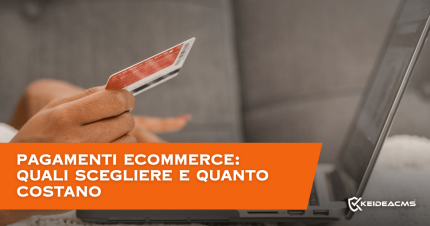
Payment methods for ecommerce: which ones to choose and how much they really cost
Offering the right payment method, at the right cost, is one of the decisions that has the biggest impact on an ecommerce store's sales and on how much margin is left at the end of the month. In this page we look at which payment methods to consider, how fees really work, how much the main gateways cost, and how to choose without surprises on your statement.
In this guide (7)
A missing payment method at checkout is one of the most direct causes of a lost sale: not an uninterested customer, but an almost completed order that stalls because it doesn't find the payment method it was expecting. At the same time, every method you offer has a cost, whether a percentage, a per-transaction fee or a recurring charge, which affects the real margin of each sale. In this page we look at which payment methods to consider for an ecommerce store, how fees really work, how much the main gateways cost and how to choose the right mix for your store.
Why payment methods affect sales
A customer who reaches checkout has already decided to buy: if at that moment they don't find the payment method they normally use, card, PayPal, bank transfer or a digital wallet depending on the audience, the purchase stops right there, not because of the product's price but because of a technical obstacle. As we saw in the article on abandoned carts in ecommerce, insufficient payment methods are among the most direct causes of abandonment right at the last step, the one where the sale seemed already done.
On the other hand, every payment method has a cost: a percentage on the transaction, sometimes a fixed amount, in some cases a monthly fee. Choosing the right methods means finding the balance between covering your audience's payment habits and not giving away margin on fees you could avoid or reduce.
Which payment methods to offer in an ecommerce store
Not all methods make sense for every store: the choice depends on what you sell, to whom and in which markets. The most common ones in Italy are these:
Credit and debit card. The most widely used method overall, handled through a payment gateway (for example Stripe) that takes care of security and settlement.
PayPal. Allows paying with the balance or with the card linked to one's PayPal account, without entering card details again: especially useful with customers who already use it on other sites.
Local digital wallets. Services like Satispay are especially popular for medium-low value purchases and for an audience that prefers to pay directly from their bank account linked to the app.
Bank transfer. No payment fee for the seller, but longer settlement times (from a few hours to a couple of business days): useful for high-value orders or for business customers.
Installment payment (buy now pay later). Allows the customer to split the amount into several installments, often increasing the average order value, but applies a higher fee to the seller than a standard card.
Cash on delivery. The customer pays on delivery: it increases the trust of those who don't want to pay online in advance, but it has an additional cost on the shipping side, which we discuss in the article on shipping and couriers for ecommerce, and a higher risk of uncollected orders.
For most stores, the starting point is a card plus a second method (PayPal or a local wallet): together they cover the largest part of the audience without multiplying the gateways to manage. Other methods are added based on a specific need, not out of habit.
How fees really work
Online payment method fees almost always follow the same structure, even though the figures vary from provider to provider:
Percentage on the transaction. A variable share calculated on the amount paid, the item that weighs most on high-value orders.
Fixed cost per transaction. An amount added to the percentage, which affects small orders much more: a fee of €0.25 on a €10 order weighs 2.5%, on a €200 order it weighs 0.125%.
Monthly or activation fee. Not all providers apply it: some gateways work only on a per-transaction fee basis, others (especially bank PSPs) may charge a fixed fee in addition to the percentage.
Surcharge on international cards or foreign currencies. If you also sell outside the European Union, almost all gateways apply an additional percentage for currency conversion or for cards issued outside the EEA.
To compare two gateways correctly, you always need all four items together, not just the advertised percentage: a provider with a lower percentage but a fixed monthly fee can cost more than one with a slightly higher percentage and no fee, especially if your ecommerce store has few orders per month.
How much do the main payment methods cost
Pricing conditions change over time and from provider to provider: before activating a service, always check the updated rates on the provider's official page. This is the public data verified as of September 2026 for Italy:
| Method | Public fee | Monthly fee |
|---|---|---|
| Stripe (EEA cards) | 1.5% + €0.25 standard; 2.8% + €0.25 on premium cards | None |
| PayPal | 3.40% + €0.35 standard; 1.20% + €0.35 with card without a PayPal account | None |
| Satispay Business | Free under €10; 0.95% from €10 upwards | None |
| Bank transfer | No fee for the seller | None |
| Bank PSPs (e.g. Nexi) | Contractual terms, vary by volume: ask for a quote | Often present |
Cash on delivery doesn't appear in the table because it has no payment gateway fee: its cost lies almost entirely in shipping management (collection on delivery, any courier surcharge), not in a percentage on the payment itself.
How to choose the right mix for your store
There's no combination that works for everyone: the choice depends on a few concrete factors specific to your ecommerce store.
Average order value. On small orders, the fixed cost per transaction weighs more: it's worth favoring methods with low or no fee on small amounts, such as Satispay under €10.
Target market. If you mainly sell in Italy, a card plus a local wallet already cover most of your audience; if you also sell abroad, always check the surcharges on international cards before setting your prices.
Type of customer. For business or high-value orders, bank transfer often remains the preferred method for buyers, because it has no fees and leaves a clear accounting record.
Purchasing device. If most of your traffic comes from smartphones, a checkout that allows payment without re-entering card details (PayPal, digital wallets) reduces friction compared to a manually filled-in card form.
The practical approach is to start with two methods that cover most of your audience, measure how much each is actually used over time, and add others only when there's a real need, not "just in case".
Common mistakes in payment management
Offering only one payment method. Even if it covers the majority of your audience, those who can't find it simply won't buy: a second alternative method reduces this risk at a limited management cost.
Choosing the gateway based only on the advertised percentage. Without looking at the fixed cost, the monthly fee and surcharges on foreign currencies, the comparison between two providers is incomplete.
Ignoring payment security. A checkout that doesn't properly handle card data and compliance (for example with the PCI-DSS standards applied by gateways) exposes you to risks that go beyond the cost of the fee: we cover this in the article on security and GDPR in an ecommerce store.
Not managing chargebacks. Every card gateway has its own procedure for disputes and refunds: not knowing it in advance means wasting precious time when the first chargeback actually arrives.
Changing gateway without checking settlement times. Before switching from one provider to another, check when funds become available in your account: a poorly planned switch can create a temporary cash flow gap.
How KeideaCMS handles payments
In building an ecommerce store with KeideaCMS, Stripe, PayPal and bank transfer are integrated into the platform's core and ready from launch day: there's no need for third-party plugins to install, configure and update separately. We don't withhold any percentage on sales: only the normal gateway fees you choose remain, the same ones you'd pay with any other ecommerce solution.
If your industry or audience needs a payment method other than those already available, let us know through the contact form: we'll evaluate it together already during the project phase, not after the store launches.